Overview
Firms in perfect competition in a free market are able to achieve both productive and allocative efficiency.
In perfect competition, there are very many firms competing. Each firm is so small relative to the whole industry that it has no power to influence the price. It is a price taker.
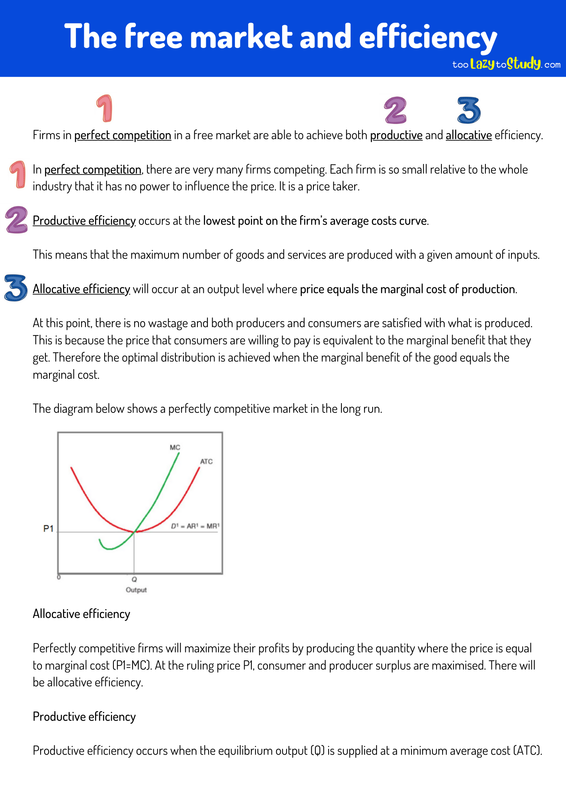
Productive efficiency occurs at the lowest point on the firm’s average costs curve.
This means that the maximum number of goods and services are produced with a given amount of inputs.
Allocative efficiency will occur at an output level where price equals the marginal cost of production.
At this point, there is no wastage and both producers and consumers are satisfied with what is produced. This is because the price that consumers are willing to pay is equivalent to the marginal benefit that they get. Therefore the optimal distribution is achieved when the marginal benefit of the good equals the marginal cost.
.png)
Economics notes on
The free market and efficiency
Perfect for A level, GCSEs and O levels!