top of page

Overview
Products that are complements will have negative values of XED.
A complementary good is a good used in conjunction with another good,
Example: cars and car tyres.
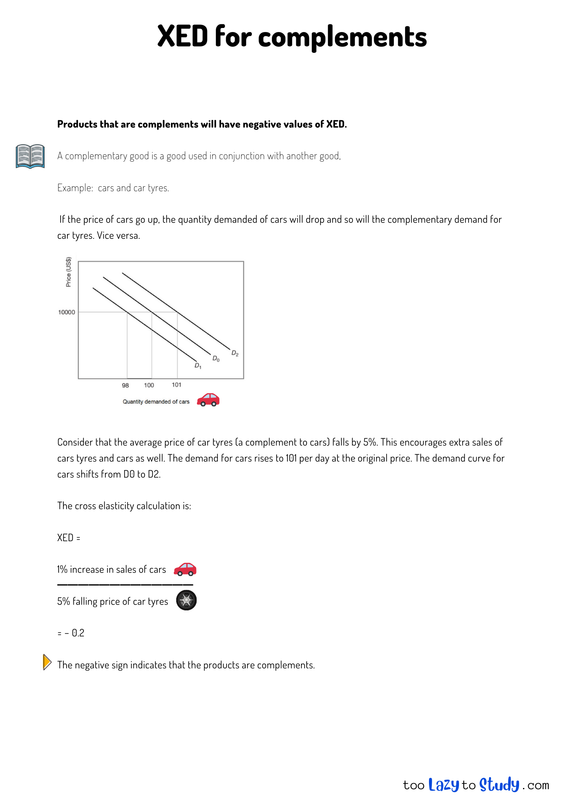
If the price of cars go up, the quantity demanded of cars will drop and so will the complementary demand for car tyres. Vice versa.
Consider that the average price of car tyres (a complement to cars) falls by 5%. This encourages extra sales of cars tyres and cars as well. The demand for cars rises to 101 per day at the original price. The demand curve for cars shifts from D0 to D2.
The cross elasticity calculation is:
XED =
1% increase in sales of cars
━━━━━━━━━━━━━
5% falling price of car tyres
= − 0.2
The negative sign indicates that the products are complements.
.png)
Economics notes on
XED for complements
Perfect for A level, GCSEs and O levels!


bottom of page